
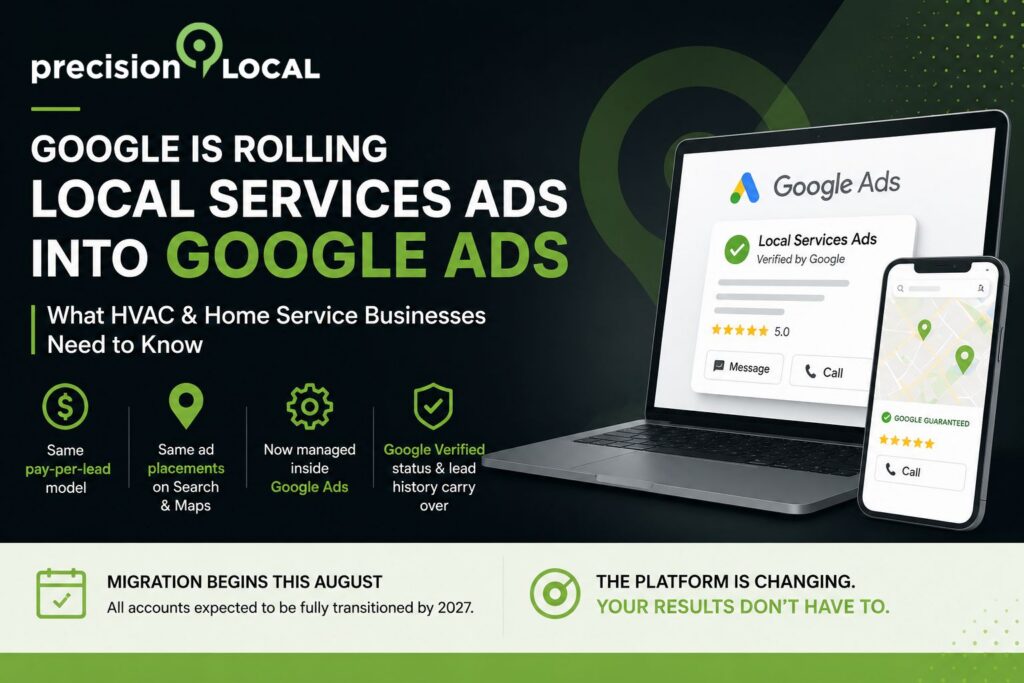
Google has announced one of the biggest changes to Local Services Ads (LSAs) since the platform launched.
Over the coming months, Local Services Ads will transition from their standalone platform directly into Google Ads. For HVAC contractors and other home service businesses, this isn’t a change to how customers find you. Instead, it’s a change to how you’ll manage your campaigns.
The good news? Your ads will continue appearing in the same places, you’ll still pay per lead (not per click), and Google’s verified business model isn’t going away.
The biggest difference is operational: everything will now live under the Google Ads umbrella.
Here’s what this means and how to prepare.
What’s Staying the Same?
The biggest takeaway is simple:
This is a platform migration—not a product replacement.
Many contractors immediately worry they’ll suddenly be paying per click or lose the benefits that have made LSAs so successful.
That’s not happening.
Google has confirmed the following will remain unchanged:
You’ll Still Pay Per Lead
Local Services Ads remain a pay-per-valid-lead advertising solution.
Unlike traditional Google Search campaigns, you won’t pay every time someone clicks your ad.
Instead, you’ll continue paying only when Google determines you’ve received a valid customer lead.
Your Ads Will Still Appear in the Same Places
Customers searching for HVAC companies won’t notice a difference.
Local Services Ads will continue appearing:
- At the top of Google Search
- On Google Maps
- In the same premium LSA placements
Visibility doesn’t change.
Management does.
High-Intent Lead Generation Remains the Goal
Google is still positioning LSAs as the fastest way to connect homeowners with qualified local contractors.
Nothing changes about Google’s focus on generating:
- Phone calls
- Booking requests
- Qualified local leads
No Keywords Required
Unlike traditional PPC campaigns, LSAs will continue using:
- Service categories
- Service areas
- Business qualifications
—not keyword targeting.
What’s Actually Changing?
This is where businesses will notice the biggest differences.
Everything Will Be Managed Inside Google Ads
Instead of logging into a separate Local Services Ads dashboard, contractors will manage LSAs directly from Google Ads.
That means one place to manage:
- Search campaigns
- Performance Max
- Display campaigns
- YouTube
- Local Services Ads
For businesses already investing in PPC, this creates a far more streamlined workflow.
Manual Bidding Is Going Away
Google is officially retiring manual bidding.
Like much of Google’s advertising ecosystem, automation will become the standard.
Expect Google to continue leaning heavily into machine learning for:
- Budget allocation
- Lead optimization
- Delivery pacing
For contractors, this means campaign strategy becomes even more important than manual bid adjustments.
Google Business Profile Becomes Even More Important
Perhaps the biggest strategic takeaway is Google’s increased reliance on your Google Business Profile (GBP).
Business information will now automatically sync into Local Services Ads.
That includes:
- Business name
- Physical address
- Hours
- Phone number
Minor updates happen automatically.
Major changes such as your primary business category or storefront address may temporarily pause campaigns while Google verifies the information.
This reinforces something we’ve been telling contractors for years:
Your Google Business Profile is no longer just a directory listing. It is now becoming the foundation of your local digital marketing strategy.
Migration Timeline
Google isn’t flipping the switch overnight.
Instead, migration will happen gradually.
Beginning in August
Home services, including HVAC, will be among the first industries transitioned.
Through 2027
Google expects all Local Services Ads accounts to be fully migrated into Google Ads.
What Happens During Migration?
Google says the migration process is largely automatic.
Here’s what businesses should expect:
Your Old Dashboard Will Disappear
Once migrated:
- The standalone LSA dashboard goes away.
- Logging in redirects you to Google Ads.
Your Verification Transfers
If your business is already verified:
- Google Guaranteed / Verified status transfers automatically.
- Insurance and license reverification won’t be required.
If Google needs additional information, notifications will appear directly inside Google Ads.
Performance May Fluctuate Briefly
Google recommends allowing up to two weeks after migration for campaigns to stabilize.
Businesses shouldn’t panic if lead volume temporarily shifts during this learning period.
What This Means for HVAC Contractors
From a strategic perspective, this update reinforces several trends we’ve been watching across Google’s ecosystem.
Google Wants One Advertising Platform
Rather than separate products, Google continues consolidating everything into one ecosystem.
For advertisers, that means:
- Simpler management
- Shared reporting
- More automation
- Better integration between campaign types
Google Business Profile Is Becoming Mission Critical
Because business information now powers both organic visibility and paid advertising, maintaining an optimized GBP has never been more important.
Incorrect hours.
Old phone numbers.
Category mistakes.
Address inconsistencies.
Any of these could directly affect advertising performance.
Automation Is Winning
Manual optimization continues disappearing across Google Ads.
Success increasingly depends on:
- Strong campaign structure
- Accurate business information
- Quality creative
- Smart budgeting
- Strategic oversight
Not manual bidding.
How PrecisionLocal Can Help
This transition doesn’t require contractors to reinvent their marketing strategy but it does require preparation.
At PrecisionLocal, we recommend every HVAC business:
- Review and update its Google Business Profile.
- Ensure business information is accurate before migration.
- Monitor campaign performance during the transition.
- Work with a marketing partner that understands both Google Ads and Local Services Ads.
The platform is changing.
Your lead generation strategy doesn’t have to. If you’d like some assistance or would like to learn how we can help manage your campaigns through this transition, please feel free to reach out to us.